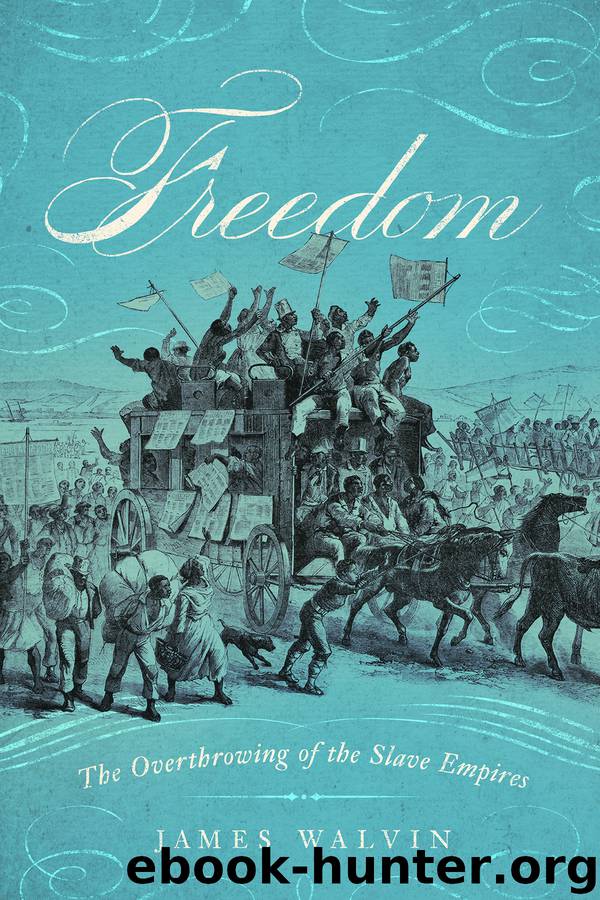
Freedom by James Walvin
Author:James Walvin
Language: eng
Format: epub
Tags: Epub3
Publisher: Pegasus Books
From the first, the American abolitionist movement faced a massive and apparently intractable problem. Not only was slavery a hugely important element in the wider economy, but untold numbers of American citizens owed their livelihoods, directly or indirectly, to slave labour. Slavery inevitably lay at the heart of US politics: five of the first seven presidents were slave owners, and Congressional politics were often in the hands of slave-holding members or interests. The South was united in its opposition to northern abolition. Northern abolition faced a wall of resistant hostility, from the state governments to local churches and newspapers, right down to the grassroots of southern life. Any anti-slavery sentiment that had existed in the South in the early years of the republic had simply drained away, and demands from the North for abolition were viewed as a threat to an entire way of life. There had been, for example, some early support for colonisation schemes (of returning slaves to Africa), but they floundered and withered in the face of the practical difficulties and failures. Though the South experienced the religious revivalism enjoyed by the North after 1830, it did not join in the northern surge for wider reform. Reform in the South meant the unthinkable – tampering with slavery. While the North experienced periodic campaigns of social and political reform (for women, socialism, temperance, organised labour), southerners seemed happy to rest on their enslaving laurels and even mocked what they regarded as the passing political fashions and fads of their northern neighbours. Southern critics denounced abolition as the subversive heir to revolutionary ideas, and from 1830 onwards, largely in response to the rising voice of abolition in the North, that defence took on a sharper and more belligerent tone.
From 1830, the growing opposition in the North to slavery was driven forward by the transformation of religious sentiment, which started in New England. Proliferating congregations of Presbyterians, Congregationalists and Unitarians spawned a ‘New Divinity’, which became the bedrock of a new, powerful anti-slavery movement. It paralleled a massive increase in following for the Methodist and Baptist churches: by 1850, for example, there were 1.25 million Methodists in the USA. They formed an army of followers who believed that they could achieve salvation by faith and appropriate behaviour on earth. And what better way was available to them than by attacking the national sin and wickedness of slavery itself?[19]
The Baptist Church had its origins in the late seventeenth century, but over the next century, missionaries and their revivalist meetings had spread the faith across the American north-east and westward along the path of migration and settlement. There were upwards of 750,000 Baptists by the mid-nineteenth century.[20] Alongside Congregationalists and Presbyterians, Baptist missionaries created a remarkable religious phenomenon that swept across the USA in the years after 1830. Inspired by some charismatic preachers, a wave of Christian revivalism transformed life in all corners of the Republic.
It was as if the USA was convulsed by a sense of personal and communal sin – and there was a religious crusade afoot to change the nation’s ways.
Download
This site does not store any files on its server. We only index and link to content provided by other sites. Please contact the content providers to delete copyright contents if any and email us, we'll remove relevant links or contents immediately.
| Anthropology | Archaeology |
| Philosophy | Politics & Government |
| Social Sciences | Sociology |
| Women's Studies |
The Great Music City by Andrea Baker(33723)
Cecilia; Or, Memoirs of an Heiress — Volume 1 by Fanny Burney(32726)
Cecilia; Or, Memoirs of an Heiress — Volume 2 by Fanny Burney(32090)
Cecilia; Or, Memoirs of an Heiress — Volume 3 by Fanny Burney(32068)
We're Going to Need More Wine by Gabrielle Union(19178)
All the Missing Girls by Megan Miranda(16740)
For the Love of Europe by Rick Steves(14940)
Pimp by Iceberg Slim(14805)
Bombshells: Glamour Girls of a Lifetime by Sullivan Steve(14223)
Norse Mythology by Gaiman Neil(13576)
Talking to Strangers by Malcolm Gladwell(13559)
Fifty Shades Freed by E L James(13353)
Mindhunter: Inside the FBI's Elite Serial Crime Unit by John E. Douglas & Mark Olshaker(9532)
Crazy Rich Asians by Kevin Kwan(9422)
The Lost Art of Listening by Michael P. Nichols(7623)
Enlightenment Now: The Case for Reason, Science, Humanism, and Progress by Steven Pinker(7441)
The Four Agreements by Don Miguel Ruiz(6919)
Bad Blood by John Carreyrou(6747)
Weapons of Math Destruction by Cathy O'Neil(6483)
